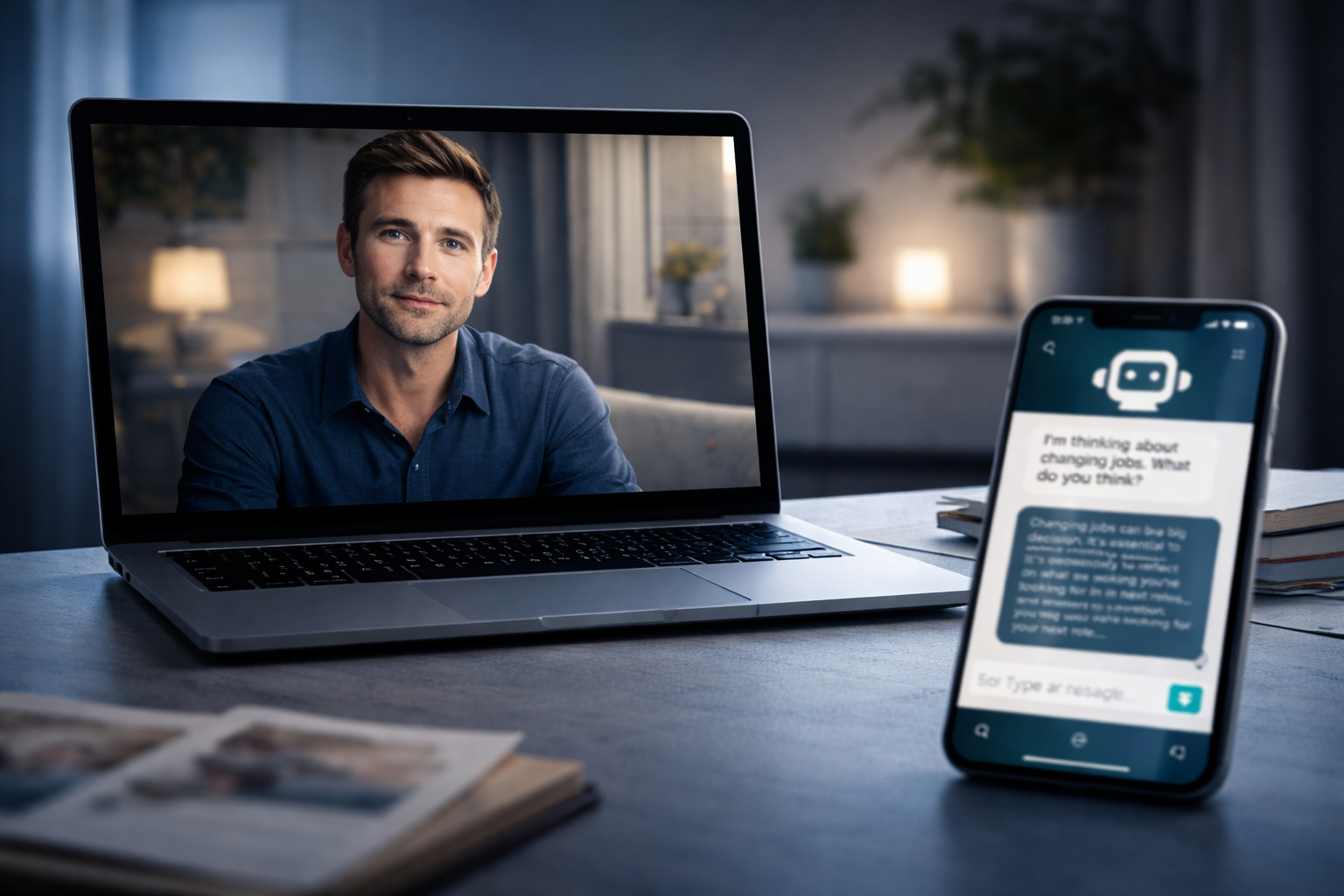
Video AI vs Chatbot AI: Why They’re Not the Same Thing
Video AI and chatbot AI are not the same technology, and they're not built for the same purpose. A chatbot generates text answers. Video AI responds with a face, a voice, and the mannerisms of a specific person — which creates an entirely different set of expectations and an entirely different responsibility.
What a Chatbot Is Built to Do
A chatbot is a text-based tool. You type a question. It generates an answer. Sometimes the answer is helpful. Sometimes it's off. Either way, you're interacting with a text box, not a person.
That's fine for what chatbots do well. They brainstorm ideas, handle tasks, and answer general questions. They're optimized for speed and usefulness. They're not trying to represent anyone specific.
When a chatbot gets something wrong, it's annoying — but you don't feel betrayed by it, because you never expected it to know you. It's a tool, and you treat it like one.
What Changes When AI Has a Face and a Voice
Video AI changes the relationship completely. When an AI looks like your grandfather — his face, his voice, the way he paused before making a point — you don't interact with it the way you'd interact with a text box. You lean in. You listen differently. You expect it to know what he knew.
That shift in expectation is everything. The AI isn't just answering questions anymore. It's representing someone. And when it represents someone you love, getting things wrong doesn't feel like an error — it feels like a violation.
That's the core of what separates an AI digital twin from a chatbot. The digital twin carries the weight of a real person's identity. A chatbot carries none.
Why Accuracy Becomes Non-Negotiable
A chatbot can speculate, infer, and extrapolate. That's part of how it works. An AI version of yourself built for your family cannot.
If a video AI confidently says something your father never believed, trust breaks instantly. Your family doesn't just lose confidence in the technology — they lose confidence in the entire experience. Every memory it retrieved accurately before that moment gets called into question.
According to a 2025 Pew Research Center report, 66% of U.S. adults are already concerned about getting inaccurate information from AI — and that's just text on a screen. When the AI is wearing someone's face and speaking in their voice, the stakes are fundamentally different.
That's why responsible platforms use closed-database architecture. The AI only retrieves what the person actually provided through structured interviews, recordings, and personal stories. If something was never discussed, the system says so. It doesn't guess. It doesn't fill gaps with internet data. That restraint is what makes it an interactive family legacy rather than an AI replica dressed up to look like someone it doesn't actually know.
How a Digital Clone and a Chatbot Are Built Differently
Chatbot AI draws from broad, general knowledge. It's trained on enormous datasets and designed to generate plausible-sounding answers to nearly anything.
Video AI for legacy preservation works the opposite way. It draws from a narrow, specific, intentional dataset — the stories, voice recordings, and personal material that one person chose to provide. The AI's job isn't to sound smart. It's to stay faithful to what that person actually said.
The millions of families already researching their heritage through Ancestry.com and interactivegenealogy.com understand the difference between a record and a guess. According to a 2024 Kings Research report, the genealogy and personal heritage market reached $6.6 billion — a sign that families take accuracy about identity seriously. When a digital clone represents someone you love, that same standard applies.
What This Means When You're Choosing a Platform
Not every video AI platform is built with this kind of restraint. Some prioritize looking impressive over being accurate. Some generate responses from open internet data rather than closed, consented material. Some don't distinguish between what the person actually said and what sounds like something they might have said.
Responsible AI legacy preservation starts with a simple question: does the system only work with material the person intentionally provided? If the answer is anything other than yes, the platform isn't built for this. Living Forever — AI is developed under Brian Will Media on exactly that principle — because the whole point of living forever through AI is accuracy, not performance.
The Bottom Line
A chatbot answers questions. Video AI represents someone your family loves. The technology may look similar on the surface, but the responsibility is completely different — and the platform you choose should reflect that.
Frequently Asked Questions
Q: What is the difference between video AI and chatbot AI?
A: Chatbot AI generates text responses. Video AI responds with a specific person's face, voice, and mannerisms — which creates expectations of accurately representing that individual, not just answering questions.
Q: Is video AI better for preserving a family member's memory?
A: For family legacy, video AI creates a more meaningful experience because your family can see and hear the person — not just read text on a screen. That presence makes the interaction feel like a real conversation.
Q: Can a chatbot accurately represent a real person?
A: Chatbots can store and retrieve text, but without a face and voice, they lack the emotional presence that makes interactions feel like talking to someone your family actually knew.
Q: Can I use AI to clone myself for my family?
A: Yes — but only on platforms built entirely on consent. A responsible AI clone of yourself starts with your explicit participation: structured interviews, voice recordings, and personal stories you choose to share. The system retrieves only what you provided — nothing else — and that's what separates an AI clone from a chatbot guessing at who you are.
Start the conversation today at Living Forever — AI.
About the Author
Brian Will is an entrepreneur and author who has founded, scaled, and exited multiple companies across several industries. He is the founder of Brian Will Media and Living Forever — AI, where he is building the future of interactive family legacy — preserving memory, voice, and perspective through AI.